ChatGPT SEO: how to get your brand recommended by ChatGPT
ChatGPT SEO is getting your brand named, and your pages cited, when people ask ChatGPT what to buy. For most buying questions ChatGPT searches the web first, so you need OpenAI's search crawler allowed, a place on the pages it reads, and a page that answers the question in a sentence it can quote.
Picked is an AI visibility tool for SEO and marketing agencies, and B2B SaaS teams. Every day it asks ChatGPT, Claude, Gemini, Perplexity and Google's AI answers the prompts your buyers ask, records which brands and pages they name, and writes the article built to become the source they quote.
Here to use ChatGPT for SEO work? Picked also finds your keyword gaps and writes the article.
84%
of ChatGPT's links went to a brand the same answer named
32 of 69
cited pages came back the next day, same question
2 of 114
cited pages were on Google's first page for the same question
20 ChatGPT answers for  LaunchOnIt and
  Leado, read from the chatgpt.com interface, US, September 27 and 28, 2026.
How it picks
How does ChatGPT decide which brands to recommend?
ChatGPT answers a buying question in one of two ways, and often mixes them.
From memory
The model was trained on a large crawl of the web. If your brand was well described across many pages before its cutoff, it can name you without searching.
From a search
For questions about products, prices and "best" lists, ChatGPT runs its own web searches, reads some of the pages it finds, and writes the answer from them. Those pages are the citations: the source chips next to a sentence and the list under the answer.
The searches it runs aren't the question the person typed. For "where to find new ai tools launching every week", one of the searches ChatGPT ran was "new AI tools launching directory Product Hunt Futurepedia There's An AI For That". It searched for the brands it already expected to name, then read their pages. That's why a brand that's already well known tends to stay in the answer, and why a Google ranking for the question doesn't carry over page for page.
The crawlers
Which OpenAI crawlers matter for ChatGPT SEO?
OpenAI runs three, and only one of them decides whether your page can be cited. From OpenAI's crawler docs, read September 29, 2026:
OAI-SearchBot- What it does
- Crawls pages for ChatGPT's search features
- Block it and
- Your pages aren't shown in ChatGPT search answers
ChatGPT-User- What it does
- Opens a page when a person's question needs it
- Block it and
- ChatGPT can't open your page mid-answer; OpenAI says robots.txt may not apply to it
GPTBot- What it does
- Collects pages that may be used to train future models
- Block it and
- Your content is kept out of training; search isn't affected
| Crawler | What it does | Block it and |
|---|---|---|
OAI-SearchBot | Crawls pages for ChatGPT's search features | Your pages aren't shown in ChatGPT search answers |
ChatGPT-User | Opens a page when a person's question needs it | ChatGPT can't open your page mid-answer; OpenAI says robots.txt may not apply to it |
GPTBot | Collects pages that may be used to train future models | Your content is kept out of training; search isn't affected |
So check robots.txt and your CDN's bot rules for OAI-SearchBot first. A rule that blocks "all AI bots" blocks this one too, and takes you out of ChatGPT's answers. You can block GPTBot and still be cited.
Several guides tell you to allow ChatGPT-User "to be cited". OpenAI says it isn't what decides that: OAI-SearchBot is. ChatGPT-User hits are still worth counting, for another reason: each one is a person asking ChatGPT a question just now, and ChatGPT opening your page to answer it.
A ChatGPT screenshot is an anecdote, not a metric.
Our data
What does ChatGPT cite?
We track two products we run, LaunchOnIt (a launch platform) and Leado (a Reddit lead-generation tool). On September 27 and 28, 2026, ChatGPT answered their 10 buyer questions once a day, US, read from the chatgpt.com interface: 20 answers.
19 of 20
Answers with at least one link
146
Links in total
123
84%Links to the site of a brand the answer named
32
22%Links to pages titled like a list ("best", "top", "alternatives", "vs")
32 of 69
Pages cited on the 27th and again on the 28th, same question
2 of 114
Cited pages that were also on Google's first page for the same question
6.8
Brands named per answer, on average
Three things follow for ChatGPT SEO:
- 1
Being named comes first
ChatGPT mostly links the brands it has already picked. The route to a citation runs through being one of the options.
- 2
Lists still matter
One link in five went to a "best X" or "X vs Y" page. Those pages are how ChatGPT decides who the options are.
- 3
Google page one isn't the target
ChatGPT's own searches found different pages from the ones Google ranks for the question.
It's a small sample from two niches. The full breakdown, with Ahrefs' figures on the sites ChatGPT cites across all topics, is in our post on ChatGPT citations.
Real answers, not a mock-up
Sources
- 1
 Product Hunt – The best new products in tech.producthunt.com17
 - 2
 How indie hackers should launch products in 2026?indiehackers.com6
 - 3
 Hacker Newsnews.ycombinator.com5
 - 4
 BetaListbetalist.com4
 - 5
 Futurepedia newsletterfuturepedia.io4
 - –
 launchon.it (You)Not cited
What to change
How do I do SEO for ChatGPT?
No one can make ChatGPT recommend you. These are the steps that give it reasons to.
- 1
Make your pages findable
Allow
OAI-SearchBot: checkrobots.txt, your CDN's AI bot settings and any firewall rule that challenges bots. Then do the normal SEO, because ChatGPT finds pages through web search and a page nothing links to is hard for it to find. And serve the facts in the HTML: OpenAI's crawler fetches JavaScript files but doesn't run them, according to Vercel's crawler data (December 2024). - 2
Get onto the pages that decide the options
Find the "best X for Y" lists, review sites, directories and comparison pages ChatGPT cites for your buyers' questions, and get listed, reviewed or compared there. Ask ChatGPT the questions yourself and open its sources: that's the list.
- 3
Give each buying question its own page
Pricing, "X vs Y" with named competitors, "best X for [use case]", alternatives, integrations. One question per page.
- 4
Answer in the first sentence
"Acme is a time-tracking tool for agencies of 5 to 50 people, from $8 a user a month" can be quoted whole. "Welcome to the future of work" can't.
- 5
Write facts, not adjectives
Prices, limits, dates, supported tools, who it isn't for. ChatGPT repeats specifics; it skips "flexible", "powerful" and "best-in-class".
- 6
Keep the page current
Put a visible date on pages with prices and comparisons, and update them when things change. A page saying 2024 prices gives ChatGPT a reason to pick a newer one.
What won't help, whatever the LinkedIn posts say: stuffing pages with the question's wording, hidden text for AI, or an llms.txt file on its own. OpenAI's crawler docs don't mention it.
Measure it
How do I check if ChatGPT recommends my brand?
Ask it. Turn on search, ask the question your buyers ask, and read who's named and what's linked. Then ask again tomorrow. Ask ChatGPT the same question three times and you'll meet three different market leaders.
Then look at your analytics. ChatGPT adds utm_source=chatgpt.com to the source links under an answer (every one of 87 in our GEO vs SEO run), so filter for it. Some links inside answers have carried no referrer at all in Ahrefs' referrer tests (May 2025), so part of ChatGPT's traffic shows up as "Direct".
A screenshot is an anecdote, not a metric. Fewer than half the pages ChatGPT cited one day came back the next, in our answers. To know whether you're winning, you need the same questions asked on a schedule, and the share of answers that name you over weeks.
That's what an AI visibility tool does. Picked asks your prompts on ChatGPT every day, reads the answer from the chatgpt.com interface, and records who's named, in what position, and which pages are cited. It also counts ChatGPT-User and OAI-SearchBot hits on your site, and on Growth and Scale writes the article for a prompt you lose. ChatGPT can be one of your AI models on every plan (see pricing). Or run the free AI visibility checker: it asks ChatGPT two of your buyers' questions right now.
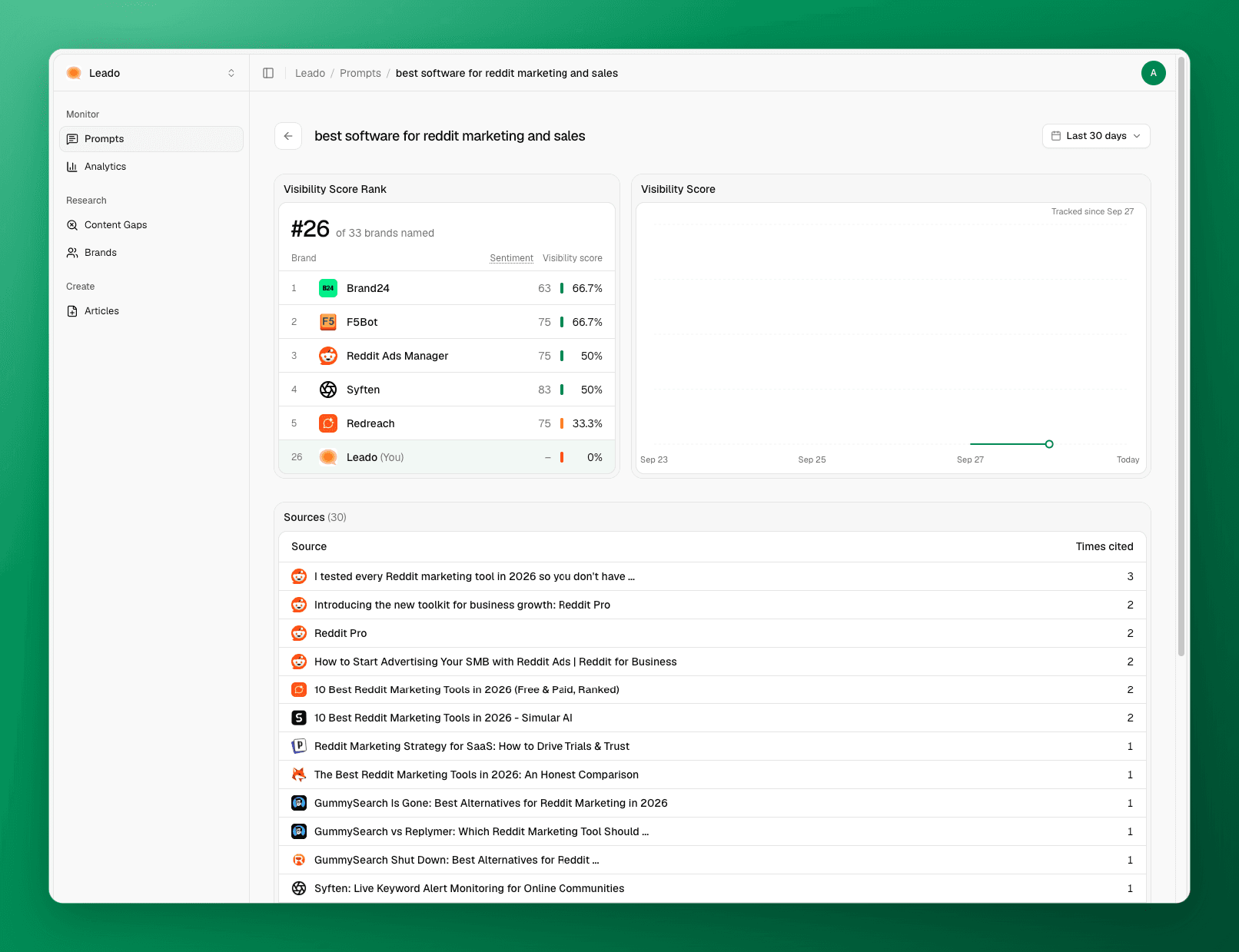
One of Leado's questions: the pages cited instead
When not to bother
When ChatGPT SEO won't work
Honest answer: sometimes this isn't worth your time.
There's no page that answers the question
If nobody, you included, has written it, ChatGPT will cite whoever comes closest.
You're not one of the options
If no list, review or thread mentions you, ChatGPT has no reason to. Fix that before rewriting your homepage.
Your buyers don't ask ChatGPT
Some don't. Ask your customers before spending a quarter on it.
Sources
How we checked
- Our answers: 20 ChatGPT answers for LaunchOnIt and Leado, September 27 and 28, 2026, US, read from the chatgpt.com interface through DataForSEO. Google's first page for the same 10 questions fetched September 29, 2026.
- OpenAI: crawler documentation, read September 29, 2026.
- Third-party studies: Vercel's AI crawler data (December 2024), Ahrefs' referrer tests (May 2025), read September 30, 2026. Both are dated where they're used; ChatGPT's link handling can change.
The other AI models
Each one reads the web its own way

Questions
Frequently asked questions
Short answers, each one checked against the vendor's own docs or our own answers.
It goes by several names: ChatGPT SEO, generative engine optimization (GEO), answer engine optimization (AEO) or LLM SEO. They all mean getting your brand named and your pages cited in AI answers. ChatGPT SEO is the part about ChatGPT specifically.
ChatGPT runs its own searches, and OpenAI's own crawler, OAI-SearchBot, decides which pages can appear in its answers. In our answers, only 2 of 114 cited pages were on Google's first page for the same question, so a Google ranking doesn't carry over directly.
For answers that search the web, a new page can be cited once OAI-SearchBot has crawled it and it matches one of ChatGPT's searches, which can take days. What ChatGPT knows from training changes only with new models. Measure over several weeks, not one answer.
You can't buy a place in ChatGPT's organic answer. What you can do is get listed and reviewed on the pages ChatGPT reads, and publish pages that answer your buyers' questions. Anyone selling a guaranteed ChatGPT recommendation is selling something they don't control.
Usually because your competitor is on more of the pages ChatGPT reads for that question: lists, reviews, comparisons, forum threads. Ask ChatGPT the question, open every source it cites, and check which of them mention the competitor and not you. That's where to start.
If ChatGPT matters to your buyers and you track more than a handful of questions, yes. Answers change daily, so one check tells you little. A tracker asks the same prompts on a schedule and shows your share of answers over time, the brands named instead and the pages cited.
Find out what ChatGPT and Google AI say about you
Add your domain and the prompts your buyers ask. Unlimited seats for your whole team, and no promises we can't keep.