LLM SEO: how to get named by ChatGPT, Claude and Gemini
 Gemini
LLM SEO is the work of getting your brand named, and your pages cited, when people ask ChatGPT, Claude, Gemini, Perplexity or Google's AI answers what to buy. The models learn from pages in training and read more through web search when they answer, so it's mostly SEO, measured on a different scoreboard.
Picked is an AI visibility tool for SEO and marketing agencies, and B2B SaaS teams. Every day it asks ChatGPT, Claude, Gemini, Perplexity and Google's AI answers the prompts your buyers ask, records which brands and pages they name, and writes the article built to become the source they quote.
61%
of the brands four AI models named were named by only one of them
0
sites cited by all four models for the same question
2 of 114
pages ChatGPT cited were on Google's first page for the same question
Our own answers for  LaunchOnIt and
  Leado, US, September 27 and 28, 2026. How we counted is at the end of the page.
Six AI models
Each one reads the web its own way
Where each model finds pages, the crawler that decides whether you can be cited, and what it named for real buyer questions.
The basics
What is LLM SEO?
LLM SEO (large language model SEO) means making your brand one of the names an AI assistant gives when someone asks about your category, and making your pages the sources it links. It's also called GEO (generative engine optimization), AEO (answer engine optimization) or AI search optimization. The names differ; the job is the same.
A classic SEO report asks where your page ranks for a keyword. An LLM SEO report asks two things instead:
Are you named?
When a buyer asks "best CRM for a 10-person agency", is your brand in the answer, and in what position?
Are you cited?
Does the answer link your page as a source, or a competitor's, a review site's, a Reddit thread?
You can be named without being cited (the model knows you from training) and cited without being named (it quotes your blog post about the category, then recommends someone else). Both count, and they're fixed in different ways.
How models find pages
How do ChatGPT, Claude and Gemini find your pages?
Every model gets to your brand by one of two roads.
- 1
Training
The model was trained on a large crawl of the web. If your brand was well described on many pages before its cutoff, it can name you from memory, with no search and no link. Each company runs a training crawler for this (
GPTBot,ClaudeBot, and for Google theGoogle-Extendedsetting). - 2
Search at answer time
For most buying questions the model runs web searches first, reads a handful of pages, and writes the answer from them. Those pages become the citations. This road runs through a search index, and each company has its own crawler or index for it.
Road two is where you can move things this month. Road one moves when the next model is trained, on whatever the web said about you by then.
Here is how each of the six reads the web, from each company's own documentation (read September 29, 2026):
ChatGPT
- Where its live answers come from
- Its own web searches before it answers
- The crawler that decides if you can be cited
OAI-SearchBot- Block it and
- Your pages aren't shown in ChatGPT search answers
Claude
- Where its live answers come from
- Web search, when the person switches it on
- The crawler that decides if you can be cited
Claude-SearchBotandClaude-User- Block it and
- Anthropic says your visibility in Claude's search answers may drop
Gemini
- Where its live answers come from
- Google Search's index, when it grounds an answer
- The crawler that decides if you can be cited
- Googlebot, plus the
Google-Extendedsetting - Block it and
- Blocking
Google-Extendedkeeps pages out of Gemini's grounding, not out of Search
Perplexity
- Where its live answers come from
- Its own search index, on every answer
- The crawler that decides if you can be cited
PerplexityBot- Block it and
- You don't appear in Perplexity's results
Google AI Overviews
- Where its live answers come from
- Google Search's index, with fan-out searches
- The crawler that decides if you can be cited
- Googlebot
- Block it and
- You leave Google Search altogether
Google AI Mode
- Where its live answers come from
- Google Search's index, with fan-out searches
- The crawler that decides if you can be cited
- Googlebot
- Block it and
- Same as AI Overviews
| AI model | Where its live answers come from | The crawler that decides if you can be cited | Block it and |
|---|---|---|---|
| ChatGPT | Its own web searches before it answers | OAI-SearchBot | Your pages aren't shown in ChatGPT search answers |
| Claude | Web search, when the person switches it on | Claude-SearchBot and Claude-User | Anthropic says your visibility in Claude's search answers may drop |
| Gemini | Google Search's index, when it grounds an answer | Googlebot, plus the Google-Extended setting | Blocking Google-Extended keeps pages out of Gemini's grounding, not out of Search |
| Perplexity | Its own search index, on every answer | PerplexityBot | You don't appear in Perplexity's results |
| Google AI Overviews | Google Search's index, with fan-out searches | Googlebot | You leave Google Search altogether |
| Google AI Mode | Google Search's index, with fan-out searches | Googlebot | Same as AI Overviews |
Sources: OpenAI's crawler docs, Anthropic's crawler article, Google's AI features guide and Perplexity's bot docs. Each model's page below goes into its own details.
One consequence people miss: you can block every training crawler and still be cited. GPTBot and OAI-SearchBot are separate switches, and so are ClaudeBot and Claude-SearchBot. Blocking training is a decision about your content; blocking search crawlers is a decision to leave the answers.
LLM SEO is mostly SEO, with a different scoreboard.
SEO vs LLM SEO
Is LLM SEO different from SEO?
Less than the people selling it say. Google's own guide to its AI features, published in May 2026, puts it plainly: optimizing for generative AI search "is optimizing for the search experience, and thus still SEO". The models search the web, and the web is still ranked, crawled and linked the way it was.
What does change:
The result
- Classic SEO
- Ten blue links, you're one of them
- LLM SEO
- One written answer that names a few brands
What you measure
- Classic SEO
- Rank for a keyword
- LLM SEO
- Share of answers that name you, and which pages they cite
The query
- Classic SEO
- A few words someone typed
- LLM SEO
- A full question, then several searches the model runs itself
How stable
- Classic SEO
- Moves over weeks
- LLM SEO
- The same question can name different brands tomorrow
Who you're up against
- Classic SEO
- Pages ranking for the keyword
- LLM SEO
- Every page the model read, plus what it learned in training
| Classic SEO | LLM SEO | |
|---|---|---|
| The result | Ten blue links, you're one of them | One written answer that names a few brands |
| What you measure | Rank for a keyword | Share of answers that name you, and which pages they cite |
| The query | A few words someone typed | A full question, then several searches the model runs itself |
| How stable | Moves over weeks | The same question can name different brands tomorrow |
| Who you're up against | Pages ranking for the keyword | Every page the model read, plus what it learned in training |
The query row matters most. When a model answers, it often rewrites the question into its own searches (Google calls this query fan-out), and those searches don't match the words the person typed. Ranking for the question itself is no guarantee of being read. In 20 ChatGPT answers we recorded, only 2 of the 114 different pages it cited were on Google's first page for the same question. The ChatGPT citations study has the details.
Our data
Do the AI models agree with each other?
Not much, and this is the part most LLM SEO guides skip. We asked four models the same 5 buyer questions for LaunchOnIt, a launch platform we run, on September 27 and 28, 2026: ChatGPT, Gemini, Perplexity and Google AI Overviews, US.
172
Brands named across the four models
105
61%Named by one model only
24
14%Named by all four
250
Sites cited across the four models
227
91%Cited by one model only
0
Cited by all four
The models mostly agree on the category leaders: Product Hunt, BetaList, Indie Hackers and Hacker News were named by all four. Past the top few, each model has its own list. And they almost never read the same pages: not one site was cited by all four models for the same question on the same day.
How they link differs just as much:
Perplexity
- Links per answer
- 20.1
- Links to a brand the answer named
- 25%
ChatGPT
- Links per answer
- 7.3
- Links to a brand the answer named
- 84%
Google AI Overviews
- Links per answer
- 6.1
- Links to a brand the answer named
- 39%
Google AI Mode
- Links per answer
- 3.1
- Links to a brand the answer named
- 52%
Gemini
- Links per answer
- 2.4
- Links to a brand the answer named
- 42%
| AI model | Links per answer | Links to a brand the answer named |
|---|---|---|
| Perplexity | 20.1 | 25% |
| ChatGPT | 7.3 | 84% |
| Google AI Overviews | 6.1 | 39% |
| Google AI Mode | 3.1 | 52% |
| Gemini | 2.4 | 42% |
Perplexity quotes lists and reviews by the dozen; ChatGPT mostly links the sites of the brands it names; Gemini names about ten brands an answer and links two or three pages. A small sample from two products, so read it as what happened there. The lesson still holds: a win on one model tells you little about the others, which is why each has its own page here.
Real answers, not a mock-up
Brands named
- 1
 Product HuntNamed by all four models33
 - 2
 BetaListNamed by all four models25
 - 3
 Indie HackersNamed by all four models22
 - 4
 Hacker NewsNamed by all four models20
 - 5
 UneedNamed by all four models17
 - –
 LaunchOnIt (You)Not named
What to change
How do I get my brand recommended by AI models?
No one can make a model say your name. These are the changes that give it reasons to.
- 1
Let the search crawlers in
Check
robots.txtand your CDN's bot settings forOAI-SearchBot,Claude-SearchBot,Claude-User,PerplexityBotand Googlebot. Blocking training crawlers is your call; blocking these takes you out of the answers. - 2
Be one of the options
Models name brands that other pages name. Get listed where your category is compared: review sites, directories, "best X for Y" roundups, forums where buyers ask. In our ChatGPT answers, 84% of links went to a brand the answer had already named.
- 3
Answer each buying question on a page of its own
Pricing, comparisons with named competitors, "best X for Y", integrations. First sentence answers the question in words a model can quote whole.
- 4
State facts a model can repeat
Prices, limits, dates, what's included, who it's for. "Flexible pricing" gives an answer nothing to say; "from $49 a month for 3 users" does.
- 5
Put the facts in the HTML
OpenAI's and Anthropic's crawlers download JavaScript files but don't run them, according to Vercel's crawler data (December 2024). A price, a comparison table or an FAQ that only appears after scripts run is invisible to them. Serve it in the page's HTML.
- 6
Keep doing SEO
Pages that are indexed, linked and fast get found by the searches the models run. Google says AI Overviews and AI Mode have no extra requirements beyond being indexed and eligible for a snippet.
- 7
Skip the shortcuts
Google says Search doesn't use
llms.txt, that you don't need to cut pages into chunks or rewrite them "for AI", and that chasing fake mentions "isn't as helpful as it might seem".
Measure it
How do I measure LLM SEO?
A screenshot of one answer isn't a measurement. Ask the same question tomorrow and you can get a different answer: in our ChatGPT answers, fewer than half the pages cited one day came back the next.
Measure it the way you'd measure rankings:
A fixed set of prompts
The questions your buyers ask, written the way they'd type them to an assistant.
Asked on a schedule
On each model your buyers use, from the country you sell in.
More than one run
One answer is a sample of one. Aleyda Solis's AI search checklist suggests asking each core prompt three to five times within a day or three before you compare; asking daily gets you there over a week.
Share of answers that name you
Plus your position when named, and the brands named instead.
Which pages each answer cites
Yours and everyone else's. That list is your to-do list: those are the pages the model trusts for the question.
Visits from AI answers, apart from citations
A cited page isn't always the page people click. In analytics, ChatGPT's source links carry
utm_source=chatgpt.com(all 87 in our GEO vs SEO run), but some AI apps send no referrer at all, so part of that traffic lands in "Direct". Ahrefs' referrer tests (May 2025) found Claude and Perplexity on the web pass it, while Copilot in Windows, Perplexity's desktop app and Grok didn't.AI crawler hits on your site
Split into training crawls and live fetches. A
ChatGPT-UserorClaude-Userhit means a person asked a question just now and the assistant opened your page.
You can do this by hand in a spreadsheet for ten prompts. Past that, it's what an AI visibility tool is for. Picked asks your prompts every day (Claude less often), records who each answer names and which pages it cites, counts the AI crawlers on your site, and on Growth and Scale writes the article for a prompt you lose. To see where you stand first, run the free AI visibility checker.
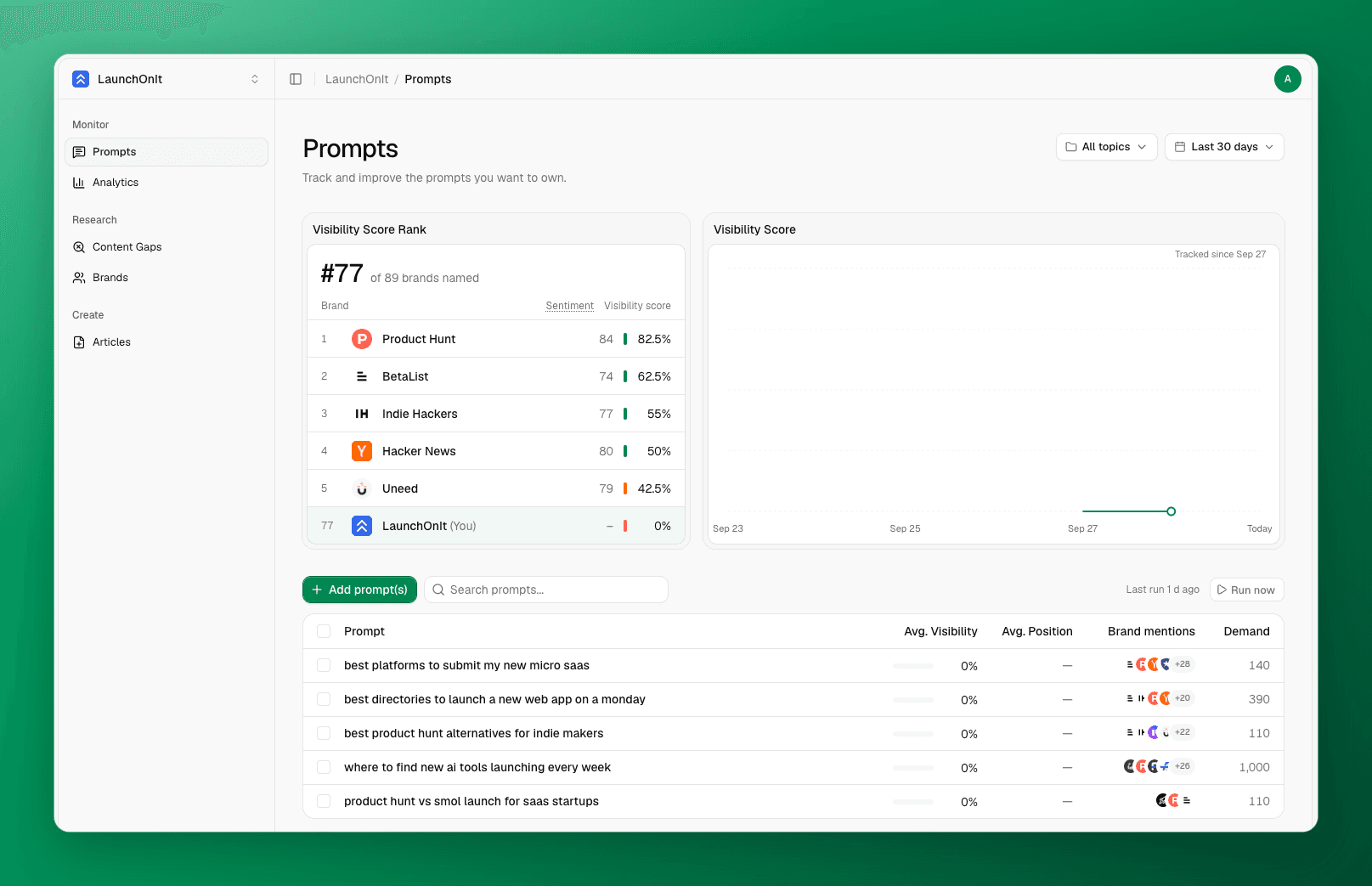
LaunchOnIt in Picked: 5 prompts, named in none
When not to bother
When LLM SEO won't help
Honest answer: sometimes this isn't worth your time.
Nobody asks an AI about your category
A walk-in trade where buyers ring three numbers from Google Maps won't find customers in ChatGPT. Local SEO pays better.
You have nothing to be picked for yet
Models recommend what the web already describes. With no product pages, reviews or listings, there's nothing to cite. Publish first.
You want a guarantee
Nobody controls what a model says tomorrow. Anyone promising "rank #1 in ChatGPT" is guessing with your money.
Sources
How we checked
- Vendor docs: OpenAI's crawler docs, Anthropic's crawler and web search articles, Perplexity's bot docs, Google's common crawlers page, "AI features and your website" and "Optimizing your website for generative AI features on Google Search", all read September 29, 2026.
- Third-party studies: Vercel's AI crawler data (December 2024), Ahrefs' referrer tests (May 2025), Chris Green's llms.txt count (May 2025) and Aleyda Solis's AI search checklist (updated September 26, 2026), read September 30, 2026. Older studies are dated where they're used.
- Our answers: LaunchOnIt and Leado, products we also run, 5 prompts each, September 27 and 28, 2026, US. ChatGPT and Gemini read from their own interfaces, AI Overviews and AI Mode from Google's results page, Perplexity through its Sonar API with web search. Brands and sites counted once per question and day; a site's
www.dropped.
Questions
Frequently asked questions
Short answers, each one checked against the vendor's own docs or our own answers.
None in practice. LLM SEO, GEO (generative engine optimization), AEO (answer engine optimization) and AI search optimization all name the same work: getting your brand named and your pages cited in AI answers. People use whichever term their tools or agency use.
No. The AI models that answer buying questions search the web first, and Google says optimizing for its AI features is still SEO. What changed is the scoreboard: you now count how often answers name you and which pages they cite, alongside where you rank.
The one your buyers use. Ask your last ten customers which assistant they asked, if any. Google AI Overviews show up on searches people already make on Google, so they reach buyers who never open an AI app. Track the few your buyers use rather than guessing, since the models name different brands for the same question.
Not for Google. Google's guide to its AI features says Google Search doesn't use llms.txt and it will neither help nor harm your visibility. Few sites use it anyway: Chris Green found a valid file on 0.011% of the Majestic Million in May 2025. Other companies haven't said they rely on it. Adding one takes ten minutes; spend the rest of the time on the pages AI answers actually quote.
Answers that search the web can pick up a new page as soon as it's indexed and relevant, so days to weeks. What a model learned in training only changes with its next version, which can take months. Track it daily for several weeks before judging a change.
Yes, for a few prompts. Ask each model your buyers' questions with web search on, on several days, and note who is named and which pages are linked. It gets slow past ten prompts and several models, which is when a tracking tool pays for itself.
Find out what ChatGPT and Google AI say about you
Add your domain and the prompts your buyers ask. Unlimited seats for your whole team, and no promises we can't keep.